1 Thessalonians 4:13 · NKJV
Grieving as a Christian: When God Feels Far (What the Bible Actually Says)
17:41 Bible Studies
What does 1 Thessalonians 4:13 say?
You still reach for your phone to call them. And somewhere in the pain is a question you're afraid to say out loud: "God, where are You?"
In this episode of Life's Hardest Questions, we open the Bible slowly to see what it actually says about grief: why Christians are allowed to grieve, why Jesus wept at His friend's grave even though He knew He would raise him, and why the Christian hope is built on the resurrection, not on wishful thinking.
The short answer: The Bible does not tell Christians to stop grieving. 1 Thessalonians 4:13 says believers should not "sorrow as others who have no hope." Grief is expected, but it is held by hope. That hope rests on the fact that "Jesus died and rose again" (1 Thessalonians 4:14). In John 11:35, "Jesus wept" before raising Lazarus. Hope does not cancel tears.
In this video:
• What Paul told a grieving church (1 Thessalonians 4:13–18)
• Why "Jesus wept" is one of the most comforting verses in the Bible (John 11)
• Why the "five stages of grief" may not describe your grief, and why that's okay
• Is heaven just wishful thinking? A fair answer to Freud's objection
• "Why did God take them?" An honest answer that avoids clichés
• Six practical steps for this week
• How to comfort a grieving friend (what not to say, and what to say instead)
• A prayer for everyone who is grieving
Chapters:
0:00 When God feels far
0:27 The question grieving Christians ask
1:09 What grief actually feels like (and the "five stages" myth)
2:24 1 Thessalonians 4: Paul writes to a grieving church
4:53 John 11: The day Jesus wept
7:55 What this means, and what it doesn't
9:05 "Isn't heaven just wishful thinking?"
10:14 "Did God take my loved one?"
11:30 Six steps for this week
13:02 How to comfort someone who is grieving
14:21 The hope of the Gospel
15:44 A prayer for the grieving
17:02 Next episode
If you are in crisis: In the U.S., call or text 988 (Suicide & Crisis Lifeline, free and confidential, 24/7) or text HOME to 741741 (Crisis Text Line). If you are in immediate danger, call 911. Grief that stays overwhelming for many months deserves care from a doctor or counselor; that is wisdom, not weak faith.
Scripture (NKJV): 1 Thessalonians 4:13–18 · John 11:21–44 · Psalm 34:18 · Psalm 88 · Psalm 56:8 · Isaiah 53:3–4 · Hebrews 4:15 · Romans 12:15 · 2 Corinthians 1:3–4 · Lamentations 3:31–33 · 1 Corinthians 15:20–26, 54–57 · Hebrews 2:14–15 · Revelation 21:3–5 · Romans 10:9
Sources: Full list in the pinned comment and at the end of our production notes. Key sources: Penn State bereavement multiplier; Lundorff et al. (2017), Journal of Affective Disorders; Stroebe, Schut & Boerner (2017); Eisma et al. (2026) grief trajectories review; Becker et al. (2007), Palliative Medicine; Pew Research Center (2021) Views on the Afterlife; Mayo Clinic on complicated grief; 988lifeline.org.
Watch next:
• Why Does God Allow Suffering? (Ep. 4) https://youtu.be/lJ1SRO77A50
• Why Is God Silent When I Pray? (Ep. 3) https://youtu.be/oiur3Mz53nU
• Did Jesus Really Rise From the Dead? (Ep. 10) https://youtu.be/SG5W2DtZZ9M
• Is My Loved One in Heaven? (Ep. 14): https://youtu.be/L9qRNPazs5o
Tell us in the comments the name of the person you're missing. We will pray for you by name.
PraiseHim Club, Bible Answers & Christian Witness. Biblical reenactments in this video are AI-generated dramatizations, not historical footage. Scripture taken from the New King James Version®. Copyright © 1982 by Thomas Nelson. Used by permission. All rights reserved.
Bible references
- 1 Thessalonians 4:13
- 1 Thessalonians 4:14
- John 11:35
- 1 Thessalonians 4:13-18
- John 11
- John 11:21-44
- Psalms 34:18
- Psalms 88
- Psalms 56:8
- Isaiah 53:3-4
- Hebrews 4:15
- Romans 12:15
- 2 Corinthians 1:3-4
- Lamentations 3:31-33
- 1 Corinthians 15:20-26
- Hebrews 2:14-15
- Revelation 21:3-5
- Romans 10:9
Scripture in this video is quoted from the NKJV.
Transcript (show)
You still reach for your phone to call them. For half a second you forget, then you remember. And somewhere in the middle of that pain, there is a second question you're almost afraid to say out loud, God, where are You? If that's where you are tonight, stay with me. You're not alone, and you're not the first believer to feel this way.
People type it into search bars at two in the morning. Why did God take my dad? Is it wrong to grieve if I believe in heaven? How do I keep believing after losing someone I love? Those aren't faithless questions.
They're human questions, and the Bible doesn't run from them. Today, we're going to open two passages slowly. One is a letter Paul wrote to a grieving church. The other is the day Jesus stood at the grave of his friend and wept. By the end, I hope you'll see three things.
Your grief is allowed, your hope has a foundation, and God is closer than he feels. Grief doesn't stay small. Researchers at Penn State estimated that every death leaves about nine close family members grieving. Most people, over time, find their footing. A 2026 review of grief research found that, on average, about half of bereaved people showed resilience, and about a third gradually recovered.
But roughly one in ten got stuck with grief that stayed intense and kept getting in the way of life. Here's something that may lift a weight. You've probably heard of the five stages of grief. Researchers who study grief say most people don't move through set stages in order. Grief comes in waves.
It loops back. It ambushes you in the grocery store. So if your grief doesn't follow a chart, you're not doing it wrong. And for many believers, there's a second layer. Researchers have a name for it: “spiritual grief.” It's the doubt, the anger toward God, and the hurt when church people say the wrong thing.
If that's you, this video was made for you. Now, let's see what the Bible actually says. Around 20 years after Jesus' resurrection, the Apostle Paul wrote a letter to a young church in the Greek city of Thessalonica. He'd only been with them a short time. Acts tells us he reasoned with them for three Sabbaths before opposition forced him out of the city.
Then something happened after he left. Believers in that church died, and the ones left behind were shaken. What happens to the people we love who have died? Here's Paul's answer. But I do not want you to be ignorant, brethren, concerning those who have fallen asleep, lest you sorrow as others who have no hope.
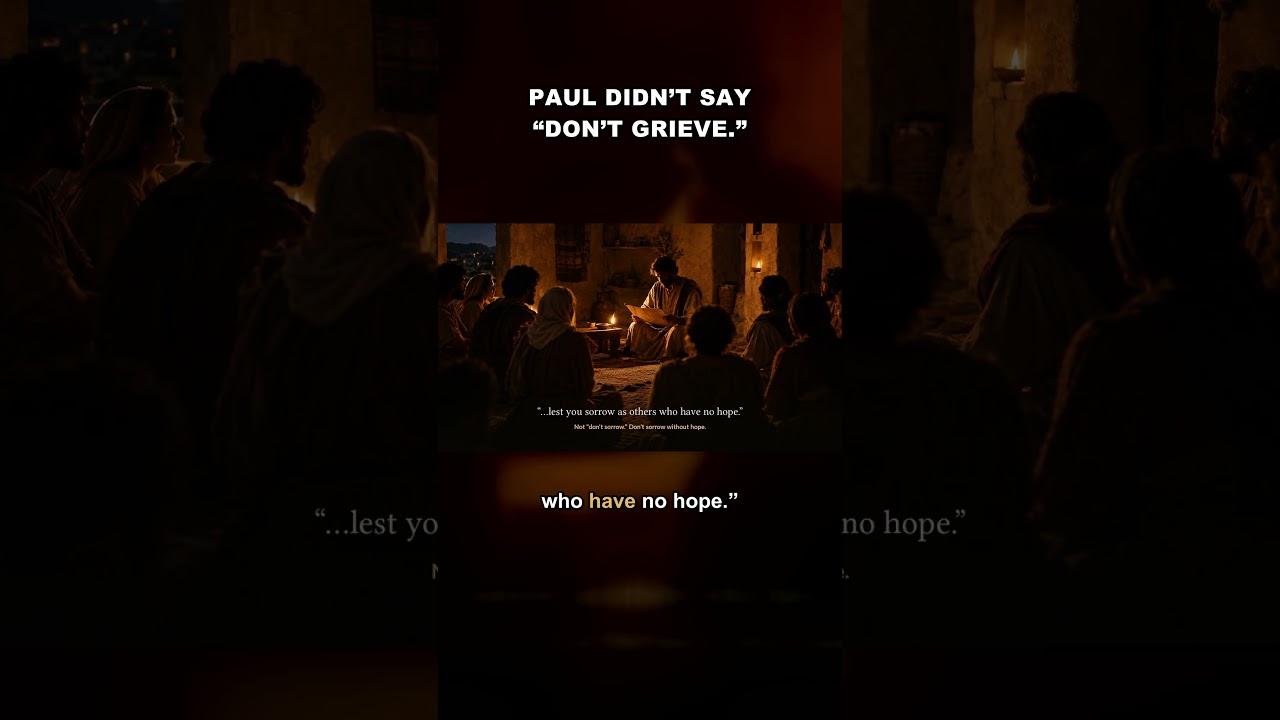
Notice what Paul does not say. He doesn't say, “Don't sorrow.” He says, “Don't sorrow the way people do who have no hope.” Grief is expected. Paul is writing to people with tears in their eyes, and he doesn't tell them to stop crying. He gives them a reason to hope while they cry. And notice the word he uses: “asleep.” In Paul's day, that was a common Jewish and Christian way to speak of death.
You don't say “asleep” about someone who will never wake up. Then Paul gives the foundation. For if we believe that Jesus died and rose again, even so God will bring with Him those who sleep in Jesus. That's the hinge of the whole passage. Paul's hope isn't “I hope so.” It's built on something that happened in history.
Jesus died and Jesus rose. If you watched our episode on the resurrection, you know that's a claim you can examine. Then Paul describes the day Christ returns. The dead in Christ will rise first. Then we who are alive and remain shall be caught up together with them, and thus we shall always be with the Lord.
Together with them, for those who belong to Jesus, death is not a permanent goodbye. It's a separation that will end. And then verse 18, “Therefore comfort one another with these words.” Paul taught about the end of the world so that grieving people could be comforted. One honest note: Christians hold different views on the exact timing of these events. We're not taking sides on that today.
What every view shares is this: resurrection, reunion, and being with the Lord forever. Let's go to a graveside. Lazarus was one of Jesus' close friends. When Lazarus got sick, his sisters, Martha and Mary, sent word to Jesus. And Jesus didn't come right away.
By the time he arrived in Bethany, Lazarus had been in the tomb for days. Martha went out to meet him and her first words were raw. Lord, if You had been here, my brother would not have died. Have you ever said that? God, if You had been there, if You had answered that prayer...
Look at what Jesus does not do. He doesn't scold her. He doesn't say, “Watch your tone.” He answers her grief with himself. “I am the resurrection and the life. He who believes in Me, though he may die, he shall live.
And whoever lives and believes in Me shall never die. Do you believe this?” Martha needed truth and Jesus gave her truth. Then Mary comes. She falls at his feet and she says the exact same sentence. Lord, if You had been here, my brother would not have died.
This time, Jesus doesn't give a theology lesson. John says that when he saw her weeping, “He groaned in the spirit and was troubled.” The Greek word behind groaned is a strong one. Lexicons define it as being deeply moved and even moved with indignation. Many Bible teachers believe this is Jesus' holy anger at death itself, the enemy that tears families apart. That's an interpretation, but it fits what Paul calls death in 1 Corinthians 15, the last enemy.
Then Jesus asks, “Where have you laid him?” Then comes the shortest verse in most English Bibles. Jesus wept. Here's what makes that verse stunning. Jesus already knew what he was about to do. Earlier in the chapter, he told his disciples he was going to wake Lazarus up.
He knew the ending. In a few minutes, Lazarus would walk out of that tomb and he still wept. If knowing the happy ending didn't stop Jesus from crying, then knowing heaven doesn't mean you have to stop crying either. Hope doesn't cancel tears. Hope gives them somewhere to go.
And then Jesus did what only he can do. He cried with a loud voice, “Lazarus, come forth!” And the man who had been dead four days walked out still wrapped in grave clothes. So in one chapter we see Jesus with us in grief and Jesus over death. He weeps beside the grave and then he empties it. Let's be careful and clear.
This means your grief is not a lack of faith. Jesus is called a Man of sorrows and acquainted with grief. He was exceedingly sorrowful in Gethsemane. Hebrews says he can sympathize with our weaknesses. It means God notices every tear.
Psalm 56 says “Put my tears into Your bottle.” Not one is wasted or forgotten. It means God is near even when he feels far. Psalm 34:18 says the Lord is near to those who have a broken heart. And here's what it does not mean. It doesn't mean grief follows a timetable.
It doesn't mean our loved ones become angels. That's a very common belief. Pew Research found that about four in ten Americans say people in heaven can become angels. But the Bible presents angels and humans as different kinds of beings. And the Christian hope is far better.
The resurrection of real bodies, real people, made new. And it doesn't mean we'll understand every why in this life. Martha didn't get an explanation. She got Jesus. Isn't heaven just wishful thinking?
This is a serious objection and it deserves a fair hearing. Sigmund Freud argued that religious ideas are fulfilments of the oldest, strongest and most urgent wishes of mankind. And when you're grieving, nothing is stronger than the wish to see someone again. Here's a gentle response in three parts. First, wanting something doesn't make it false.
A thirsty person wants water and water is real. Explaining why someone believes something doesn't tell us whether it's true. Second, the argument cuts both ways. If desire can shape belief, someone could also wish there were no God to answer to. So the real question isn't, what do we want?
It's, what happened. And third, that's exactly where Paul puts it. Not “I wish,” but “if we believe that Jesus died and rose again.” Christian hope rests on a historical claim about an empty tomb and eyewitnesses. You can test it. We walked through that evidence in Episode 10.
If God is in control, didn't he take my loved one? How can I trust him? I won't give you a cheap answer to that. Christians describe God's role in death in different ways. Some emphasize his sovereign hand like Job who said “The Lord gave, and the Lord has taken away.” Others emphasize that we live in a fallen world where death is a result of sin.
Both agree on this. Death is an enemy and God takes no pleasure in our pain. Lamentations says he does not afflict willingly, Nor grieve the children of men. We usually aren't given the reason but we are given the person. Jesus didn't hand Martha an explanation.
He said “I am the resurrection and the life.” And if you're carrying a quieter fear, what if my loved one didn't know Jesus or what if they took their own life? I want you to know we'll treat that question with care in the very next episode. For now, hold on to this. Shall not the Judge of all the earth do right? He knows things about your loved one's heart that you never could.
So what do you do this week? Here are six small steps. One, lament out loud. Read Psalm 88. It's a prayer from someone in deep darkness and it ends without a neat resolution.
God put that Psalm in the Bible. That means you're allowed to pray it too. Two, say their name. Tell a friend one story about the person you lost. Grief gets heavier when it's kept quiet.
Three, let people in. Jesus asked his closest friends to stay near him in Gethsemane. Find a church grief group. Many churches host a program called GriefShare, or ask your pastor to sit with you. Four, write one honest sentence to God in a journal.
Lord, if You had been here, then write what Jesus said to Martha underneath it. Five, memorize one verse. Psalm 34:18. The Lord is near to those who have a broken heart. Six, get help if you're stuck.
If grief is still overwhelming months later, if you can't function, or if you feel life isn't worth living without them, please talk to your doctor or a counselor. That isn't weak faith, it's wisdom. If you are having thoughts of ending your life, call or text 988 in the U.S. right now. It's free, confidential, and open 24/7.
Maybe you're watching for someone else. You want to help a grieving friend and you're afraid of saying the wrong thing. First, what not to say. God needed another angel. Everything happens for a reason.
At least they're not suffering. Even when it's well meant, it can feel like a door closing. Instead, follow this pattern. Listen, ask, stay, and only then share. Ask, would you tell me about him?
Ask, what's been the hardest part? Ask, where are you with God in all this? And then listen, even if the answer is anger. Romans 12 says, “weep with those who weep.” Not “fix those who weep.” And when the moment is right, sometimes weeks later, you might say, “Can I show you something that helped me?” Jesus cried at his friend's funeral, even though he knew how the story would end. Then read John 11 together.
If your friend isn't a Christian, don't rush. Love them through the funeral, the casseroles, the first holidays. People rarely remember your words in the first week. They remember that you came. Here's why the Christian hope is different.
The Bible says death was never part of God's original good design. Through one man, sin entered the world and death through sin. And the wages of sin is death. But God didn't stay distant from our death. He came into it.
Hebrews says Jesus took on flesh and blood that through death He might destroy him who had the power of death and release those who through fear of death were all their lifetime subject to bondage. Jesus died on a cross for our sins. Three days later, he rose. And Paul says, now Christ is risen from the dead, and has become the firstfruits of those who have fallen asleep. Firstfruits means the first of a harvest.
His resurrection is the first. Ours will follow. So the question Jesus asked Martha, he asks you. “I am the resurrection and the life. Do you believe this?” If you've never trusted him, Romans 10:9 says, if you confess with your mouth the Lord Jesus and believe in your heart that God has raised Him from the dead, you will be saved.
And one day, for everyone who belongs to Him, God will wipe away every tear from their eyes. There shall be no more death, nor sorrow, nor crying. Let's pray together. Father, You know the person watching right now. You know the name they're carrying.
You know the empty chair, the voicemail they can't delete, the day of the week that still hurts. Lord Jesus, You stood at a grave and wept. Thank You that You're not embarrassed by our tears. Please be near to the brokenhearted right now, just as You promised. For the one who is angry, give them the courage to tell You the truth like Martha did.
For the one who feels numb, hold them when they can't hold on. For the one who has been grieving for a long time and feels stuck, lead them to people who can help, a pastor, a counselor, a friend, and keep them safe. For the one who doesn't know You, open their eyes to see that You are the resurrection and the life. Teach all of us to weep with those who weep and to comfort others with the comfort You've given us until the day You wipe every tear away. Keep us close.
In the name of Jesus, who conquered death. Amen. If someone you love is grieving right now, send them this video. You don't have to say anything perfect. Just let them know you're thinking of them.
In the comments, tell us the name of the person you're missing. We'll pray for you by name. Next time, we'll answer the question many grieving people are afraid to ask. Is my loved one in heaven? Subscribe so you don't miss it.
And remember, you can grieve and still have hope.
Transcript from the video's captions on YouTube.
Related videos
 Short
0:39
 Video
12:54
Genesis 2:18
Why You Feel Alone — and What God Says About It
Why do I feel so alone — and what does God actually say about it? Not "just go to church" or "just pray more." The honest, hopeful answer fr...